First-Principles Analysis of an Idealized BLDC Motor
20 February 2026physics
Introduction
A couple of years ago, I got interested in drones. I wanted to build one, but I needed to understand how to choose various components. This led me to explore the surprisingly rich physics of brushless DC motors and simplified propeller physics. This post is a cleanup of my notes on motors from this time. What I propose here is a derivation of the performance of a brushless direct current (BLDC) motor from its geometry.
BLDC motors are based on a simple idea, but their analysis is quite interesting and I really enjoyed working on it and I hope you will enjoy reading it as much. We will derive an expression for the two famous motor constants KV & Kτ that describe the relationship between applied current and torque and voltage.We will:
Model the magnetic circuit
Derive torque from Lorentz/magnetic dipole interaction
Derive back-EMF from Faraday
Show that Kτ=KV
Compare our model with a real drone motor
BLDC Motor structure
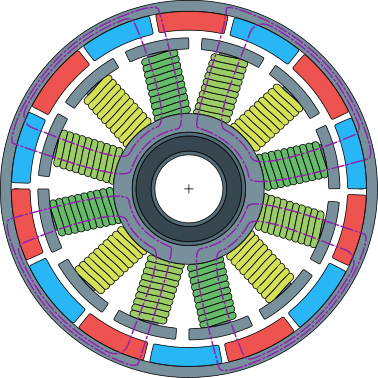
Before we begin analysing the BLDC motor, it's useful to be familiar with its different components and how they interact to make the motor spin. Here is a representation of a BLDC motor:
BLDC motors are cylindrical objects composed of two pieces:
A stator: (static) depicted as the central part of the motor. It is composed of s electrically controlled electromagnet called slots disposed radially. Slots are grouped in three phases depicted in ( ). Slots are connected by a core () usually made from a ferromagnetic material (Usually "laminated silicon steel to mitigate eddy currents").
A rotor: (rotating) around the stator composed of p permanent magnets called poles disposed with an alternation of north and south poles depicted in ( ) inside the edges of an enclosing ().
The functioning principle is simple: stator electromagnets exert a force on the permanent magnets of the rotor, driving the motor rotation.
To understand BLDC motors, a powerful tool to get familiar with is the magnetic circuit.
Magnetic circuit
Everything starts from Ampere's law for a static electric field in vacuum:
Ampere law
∇×B=μ0j
The curl (∇×⋅) of the magnetic field (B) is equal to the permeability of the vacuum μ0 times the electric current density j.
However, things are a bit different in mater. To understand why, we need to differentiate between different "kinds" of currents:
bound currents: tiny loops of currents inside atoms (denoted jb)
free currents: currents in conductors/charges moving through space at a "macroscopic level" (denoted jf)
We can then split the magnetic field B into two fields M and H associated to the type of current and verifying:
∇×M=jb. M is called the magnetization field
∇×H=jf. H is called the magnetizing field
such that:
B=μ0(M+H)
In some materials (ferromagnetic ones), the magnetization field depends on H. In the absence of the H field, atomic magnetic dipoles are oriented randomly due to thermal agitation and cancel out at a macroscopic scale. However, when a sufficiently powerful field H is applied, they tend to align, creating a net magnetization M.
We will suppose that this magnetization is proportional to the applied field H such that there exists a simple relation B=μμ0H (i.e. M=(μ−1)H⟺H+M=μH). Reality is more complex, but this approximation is sufficient for the scope of this article.
With this approximation we can write that in a linear, homogeneous material with constant μ, combining ∇×H=jf and B=μμ0H we obtain locally:
∇×B=μμ0jf
Another very useful theorem in the context of electromagnetism is the Stokes theorem:
Stokes theorem
∬A(∇×B)⋅dA=∮LB⋅dL
Where A is an oriented surface with border L. dA is the vector orthogonal to the surface with magnitude equal to the area of the infinitesimal surface element dA. dL is a vector tangent to the border L of magnitude equal to the length of the infinitesimal border element dL.
Combining it with our expression for the magnetic field inside a ferromagnetic material, we get that inside a ferromagnetic material we have for a current of intensity I traversing the surface A:
μμ0I≜∬A∇×Bμμ0jf⋅dA=∮LB⋅dL
i.e., the circulation of B on a closed loop L is equal to the quantity of current I that passes inside this loop multiplied by μμ0.
So if we take two loops of equal length, one which passes through a vacuum and one that passes through a ferromagnetic material with μ=1000, the circulation of B around the loop that passes through the ferromagnetic material will be 1000 higher. In other terms, the magnetic flux tends to flow through ferromagnetic material.
As an example, if we consider a loop of length L and cross-section A made of ferromagnetic material with a copper coil wrapped around it N times and traversed by an intensity I, we get the average circulation of the magnetic field lines loops inside the core (the ferromagnetic loop):
A1∬Aμμ0NIdAμμ0NINI=A1∬A∮LB⋅dLdA=A1∮L∬AB⋅dAdLbecause dA and dL are pointing in the same direction=μμ0AL∬AB⋅dAaverage circulation of B over the cross section of the core is constant
Finally, by introducing the following definitions:
Φ≜∬AB⋅dA the magnetic flux through surface A
F≜NI: the magnetomotive force
R≜L/(μμ0A): the reluctance
We get:
FNI=Rμμ0ALΦ∬AB⋅dA
This is Hopkinson's law:
Hopkinson's law:
F=RΦ
This law can be thought of as a magnetic circuit analog of Ohm's law U=RI for an electric circuit. In fact, we can push the analogy further using this table:
Electric
Magnetic
Current I
Flux Φ
Resistance R
Reluctance R
Electromotive force E=∮LE⋅dL
Magnetomotive force F=∮LH⋅dL
Ohm's law E=RI
Hopkinson's law F=ΦR
Kirchoff's voltage law RT=R1+R2+…
Ampère's law RT=R1+R2+…
Kirchoff's current law I1+I2+⋯=0
Gauss's law Φ1+Φ2+⋯=0
As for an electric circuit where current prefers the path of least resistance, enabling the confinement of current inside copper wires, magnetic flux prefers paths with low reluctance, enabling the confinement of magnetic field lines in ferromagnetic materials.
It is interesting to compare the ratio between the resistance of typical wires and the resistance of air with the ratio between the reluctance of typical silicon steel (a material commonly used for the core of electromagnets) and the reluctance of air. See link for the resistivity of copper and air and [link](https://en.wikipedia.org/wiki/Permeability_(electromagnetism) for the permeability of electrical steel and air
This means that magnetic circuits are more prone to leakage than electric circuits.
However, in this article, we will neglect leakage as an approximation and consider that all the flux created inside the core is exiting from the tip of the core.
Magnetic circuit components
We can describe different parts of a magnetic circuit by the relation between H and B:
Air gap
In air, the magnetic field behaves as in free space, there are no bound currents, i.e., M=0 and
B=μ0H
Magnetic core
In a magnetic core, we have:
B=μμ0H
With μ∼1000 a dimensionless constant called the relative permeability of the material.
Permanent magnet
A permanent magnet is like a ferromagnetic material where all the magnetic dipole moments are already aligned, thus the field H adds up to the magnetization M, i.e.
B=μ0(H+M)
Coil
A coil is exterior to the medium where field lines are, but as it is composed of free currents, it will influence the field H through the relation:
∇×H=jf
We can obtain the integral version of this formula using Stokes' theorem along the magnetic circuit loop (do not confuse it with the coil loop, which is an electric circuit):
F≜∫LH⋅dL=∬Ajf∇×H=NI
Thus
F=NI
BLDC Magnetic circuit
We are now equipped to describe the magnetic circuit properties of a BLDC motor. A typical magnetic field line (depicted in ) will pass
inside the coil through the magnetic core,
through an air gap between the magnetic core and a magnet
through a magnet
through the rotor enclosing
through another magnet
through another airgap
through another coil
and finally get back to its starting point by passing through the core.
To simplify the math, we can analyze just half of this loop. We "cut" the loop at its axis of symmetry. By closing this path with virtual segments where the magnetic field H is zero or perpendicular to the path, we can apply Ampère's Law to a single "branch" of the motor.
For this unit circuit, the circulation of H is equal to the enclosed current NI (the Ampere-turns of one slot):
∮LH⋅dL=NI
Expanding this across the different materials (Magnet, Gap, Core, and the virtual segments where H is zero), we get:
τM the torque resulting from the magnetic forces FM
τL the torque corresponding to the load of the motor (e.g., the torque produced by the air opposing the rotation of the propeller)
bθ˙ is the viscous forces with b the viscous damping coefficient
We introduce some more notations about the geometry of the motor.
r is the radius of the motor (from the center of the motor to the center of the permanent magnets)
h is the height of the motor (height of the magnets)
By definition, the torque τM is
τM=r×FM
FM is given by the force applied by a magnetic field B on a magnet with a magnetic dipole moment m. It is:
FM=∇(B⋅m)
In our case:
The magnets on the rotor are pointing radially, and we will approximate them with an alternating magnetization M=Mˉcos(θp/2)ur (something close to this can be obtained with appropriately shaped magnets) Note that the magnetization is the density of magnetic dipole moment M=dm/dV.
We will suppose that B is approximately uniform at the tip of the coil (B=Φ/Aur)
For our magnetic circuit, the flux is given by Hopkinson's law:
Φ=RFNI=RNI
Note that here, we don't include the magnet contribution to the magnetomotive force because we are interested in the force exerted by the coil on the magnet, (later when computing the back-EMF induced on the coil by the magnet, we will treat magnets as a source of magnetomotive force). Integrating over the surface of the gap and supposing that the magnetic field is uniform over this surface (e.g. B=Φ/Agapur), we have:
Here we see that 1−exp(iπp)=0 because p is even, thus we also need to have 1−exp(3πsp)=0 for the torque to be not null, i.e.
p=32nsn∈N
Note that in real motors, the torque is not necessarily null when this condition is not satisfied. However, in general torque will be lower due to harmonic cancellation. If we now substitute p at the third line, things simplify nicely, and we get:
Thus, n must not be a multiple of 3 for the motor to produce torque. And in this case, the torque magnitude is:
τM=≜Kτμ0231+g/wsNrhMˉIˉτM=KτIˉ
It means that the torque τM is proportional to the intensity Iˉ we apply to the motor and also proportional to the radius r, height h of the motor, the number of turns N of the coil, the magnetization Mˉ of the permanent magnets and inversely proportional to one plus the ratio between the size of the air gap and magnet width. On a side note, the number of coil turns that one can pack scales linearly with the radius, such that, as a rule of thumb, the torque scales like r2h, the volume of the motor.
Motor power
Let's now analyse the power required to make the motor spin. As the rotor spins, the magnetic field oscillates. It creates an electric field E that will generate an electromotive force (back-EMF) in the winding. This force will act as a power supply of voltage VEMF (it is the same principle as a dynamo). The Maxwell-Faraday law tells us the strength of the back-EMF:
The flux Φ is computed using the same magnetic circuit approach as before, but using the permanent magnets as the source of the magnetomotive force instead of the coils. The magnetization can be seen as a measure of the quantity of current loops that a line is traversing when passing through it. It is expressed in ampere per meter. The magnetomotive force associated with a field line is thus:
F=Agap1∬Agap∫LM⋅dℓ
And In our case with magnetization M=Mˉcos(θp/2)ur over a surface spanning an angle 2π/s and height h at a distance r from the center, integrating over the magnet width w we get:
Trying to estimate Lturn and Awire can be tricky. So I will not give an estimation formula. But you can notice that Awire will scale like sNr2 and Lturn will scale like h+Cr with C a constant thus the resistance roughly verify:
Based on the data sheet/pictures/drawings, and common material properties:
Geometry: r≈20 mm (0.02 m), h=7 mm (0.007 m).
Magnets: Neodymium (sintered), so Mˉ=9.5×10⁵ A m−1. (since Br≈1.2 T and Br=μ0Mˉ)
Windings: Let's estimate N=25 turns per slot (counting on the picture they say single wire thick but it seems to have two layers).
Configuration: s=18, p=24 (counting on the pictures).
Air gap/Magnet ratio: 1 (from the pictures the air gap is about the same size as the magnet thickness).
Resistance: R=452 mΩ (from the data sheet)
Using our formula for Kτ we have:
Kτ=μ0231+g/wsNrhMˉ
Substituting the values:
Kτ=(4π×10−7)×0.866×218×25×0.02×0.007×9.5×105≈0.0326 N m A−1
Now, let's convert KV to (RPM/V). In SI units, (rad/s per Volt). To get the hobbyist unit (RPM/V) (remember that 1 V=1 N m s−1 A−1):
KV (RPM/V)=2π⋅Kτ60=0.03269.55≈292 RPM/V
Metric
Theory
Reality (Manufacturer Spec)
Gap (%)
KV
292 RPM/V
300 RPM/V
2.7%
Kτ
0.0326 N m A−1
0.0318 N m A−1
2.5%
A 2-3% error is actually good for a first-principles derivation! I probably got lucky with the parameters I chose, but it shows that the model is capturing the essential
physics of the motor. In reality, there are many other factors that can affect the performance of the motor, such as:
Non sinusoidal magnetization and current waveforms
Magnetic saturation of the core
Magnetic leakage
Non-uniformity of the magnetic field
Eddy currents and other losses
Manufacturing imperfections
Temperature effects on the resistance and magnetization
Conclusion
In this article, we have derived from first principles the magnetic circuit properties of a BLDC motor and used them to compute the torque and power of the motor. We have also compared our theoretical predictions with the specifications of a real motor and found a good agreement. I really enjoyed writting this article, it was a great opportunity to apply the concepts of electromagnetism that I learned in school to a real-world application. I hope you enjoyed reading it as much as I enjoyed writing it! If you have any questions or suggestions for improvement, please feel free to reach out to me.